The joys and sorrows of writing a book

Writing

I’ve been busy. Really busy. Busier than a bee on crack. In between a packed schedule of web copywriting jobs I’ve been writing a book on freelancing. Here’s what I’ve learnt about writing books:

1. Books take longer to write than you think. I thought it would take a couple of weeks, but I hadn’t factored in the time required for research and interviews.

2. Books are fairly easy to write if you have a cast-iron deadline. I’m staring down the barrel of my publisher’s deadline. I dare not disappoint them.

3. Books require planning. The spreadsheet has been my friend. With everything planned from the very beginning, I’ve been able to pace the production. The spreadsheet doesn’t write the book, but it does give you a blueprint.

4. Books demand a long, steady effort. You can’t just vomit up a book. They take time. And a persistent effort. It’s not always easy to keep a book chugging along, especially when you hit the sections that don’t ignite your passions.

5. The last long lap is the hardest. Nearly there!

So there aren’t really any sorrows – not with this book at least. Not yet.

Piling spam upon spam: why unsubscribe confirmation emails are evil

Spam, Now with Real Bacon!

Picture this, if you will:

You are a busy person. You get too many emails. Loads of those emails are irrelevant, but you get them every month, like really shit clockwork. You’re clever, so you take the time to unsubscribe. It takes a few clicks, but it’s a good investment of your time. You’re all done and you feel happy: one less piece of junk mail and few less RSI-inducing clicks.

Then, THE BASTARDS SEND YOU ANOTHER EMAIL.

Disappointed that you’ve abandoned them, the automated marketing machine sends you a good-bye message. So the marketing spammers recognise your desire for less email, and send you one last email.

Why can’t they just let it go? And why do some unsubscribe options demand a password that you didn’t even know you had?

If people want to leave your unstoppable spam machine, just let them. And never darken their inbox again.

WriteClub in London

WriteClub, the casual networking meet-up for writers, is visiting London!

We’re continuing our mission of bringing writers together to chat, mingle and inspire each other.

The first WriteClub London meet-up is Tuesday 1 December.

Location: Yorkshire Grey pub, 46 Langham Street, London, W1W 7AX

For more details check WriteClub

Overwhelmed by Blogs? A Strategy for Reading Less and Learning More

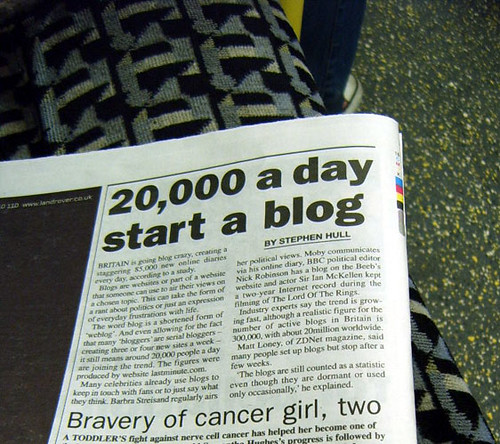
Britain Going Blog Crazy - Metro Article

There are a lot of blogs out there – too many to read. It’s easy to get overwhelmed by blogs, with an RSS reader riddled with unread posts, or hundreds of bookmarked sites that you’re never going to revisit.

The Other Problem with Blogs

If you read a handful of blogs about SEO, or copywriting, or fruit farming, you’ll probably end up reading similar opinions in similar blogs by a bunch of people that you don’t know. It’s easy to waste time reading recycled ideas.

Going Local

I have a new strategy for reading blog posts, which brings me nice ideas and doesn’t overwhelm me, and I thought I would share it.

Step 1

I check the Brighton New Media website. (This website collates posts from Brighton’s digital media bloggers – so I can read them all in one place.)

Every day or two I peruse the new posts. I read as many as interest me, and leave comments wherever possible.

Step 2

I’m a regular Twitter user, so I tend to discover good blog posts from my Twitter friends. People share the good stuff, so it’s reasonable to assume that the good stuff will find its way to me, eventually.

So sure, I may be missing all kinds of wonderful stuff, but even if I spent most of my working life reading blogs, I’d still miss something.

For those not in Brighton…

The Brighton New Media (BNM) website is central to my strategy, so what should you do if you like my approach but don’t live in Brighton? I don’t know! Perhaps you could set up a BNM equivalent for your town.

Credit Crunch Lunch?

As the global economic downturn continues to bite chunks out of our prosperity, people seek new ways to cut costs. ‘Credit crunch lunch’ is one of my favourite terms – describing a frugal feast – referring to anything from home-made sandwiches to budget banquets at upmarket eateries.

But a ‘credit crunch lunch’ is not always a happy meal; for one of my fellow co-werkers, the reality of the credit crunch lunch is this horrible mess:

creditcrunchlunchjpg

What is this? I don’t know. I didn’t know the day it barked at me from the fridge and I don’t know now. Is it spam? Is it dog meat? Is it minced ham and chips?

Refusing Blogs – Should You Tell Clients: “No blog for you!” ?

Hard work can hurt
Blogging is hard work. It’s not a quick, easy way to build web traffic. It’s time consuming and easy to get wrong. So should web developers and social media consultants be less keen to offer them to clients?

Andy Budd recently blogged about social media consultants, and his post got me thinking.

As Andy points out, many corporate blogs are dull, unpopular and don’t reward the effort expended on them. Some organisations are never going to be able to blog well. If everyone’s too busy – or too bored – to blog, what’s the point in having one?

Should web developers and social media consultants think twice before loading another organisation up with a blog? Perhaps there should be a test to prove commitment to the blog before you’re allowed to have one.

Of course, the question of whether blogs are suitable for an organisation applies to other social media tools. And I think that’s the point – not all social media tools suit all organisations.

It reminds of me of pet ownership. Everyone wants a pet, but nobody wants to pick up the poop, or walk it. Well, you want to walk it at first, when it’s fun. But then it’s cold, or raining, or Top Gear is on, and you don’t want to walk it any more. Who is going to keep blogging when Top Gear is on?

(Picture courtesy of normalityrelief via Flickr)

Creating a Web Presence – Why Bother?

The Short Version:

If you don’t have a web presence, your competitors will overtake you. You’ll miss out, without ever knowing about it.

The Long Version:

I recently worked with a new client who has very little presence on the web. One of the first things I do when a new client gets in touch is Google them.

I’m not being nosy; I want to know:

  • who they are
  • what they’ve done
  • what they’re doing
  • what people are saying about them
  • what they’re saying about other people

It’s important to me that my clients are reputable, respected and not notorious for late payment, spamming or other nefarious activities. And I think Googling a business or individual is the very least you should do to check someone’s credentials.

Now, this particular new client had almost no mentions on the web. Which seemed weird. So I asked my new client if they had a web presence and she said:

“I have a web domain but I’m yet to develop it and I have a linked in account but don’t check it. What advantages does a social media presence have?”

Rather than reply by email, I thought this was a good opportunity to blog about the reasons for having a web presence – a chance to create a blog post that I can point other clients and colleagues towards when this question arises.

So, what is the value of being mentioned on the web, and maintaining a healthy social media presence? The value is manifold:

Supporting Evidence

It’s nice to see evidence of a person’s life – their actions, their works – the web is a perfect place to scatter this evidence.

Connections

Who do you know? Who have you worked with? The web lets you demonstrate your connections in a way that feels more genuine than anonymous claims in a CV. LinkedIn is especially good for showing connections and displaying recommendations – all deeply authentic because it links you to the actual people you’ve worked for.

Sense of Self

Your web presences allow you to give a bit of yourself away. Don’t be a cold, flat CV – be a human being with opinions, preferences, idiosyncrasies and embarrassing musical tastes (see Last.fm).

Build Trust

Every time your name appears on the web, it increases the sense that you are a real person who does real things, and who can be relied upon in a real sense. If someone Googles your name and finds nothing but a private Facebook profile, they have learnt nothing. Give searchers everything they could possibly want.

Networking

The web is incredibly democratic – you can speak to anyone on Twitter and (if you go about it in the right way) get their attention.

Industrious social media operators can side-step traditional recruitment processes and make friends with potential employers. Social media tools like Twitter and FriendFeed give you access to interesting individuals – and the chance to make their acquaintance.

How do you do all this?

It’s easy! Just follow my twelve-step program:

  1. Read blogs
  2. Join Twitter
  3. Read blog posts about Twitter, like this one
  4. Start a blog.  If you’re technologically-challenged, use WordPress.com, TypePad or Blogger
  5. Tweet regularly
  6. Blog regularly
  7. Comment on other blogs in fields that interest you
  8. Use @replies on Twitter if you have something interesting to say (that ensures the recipient sees your tweet)
  9. Join FriendFeed
  10. Maintain your LinkedIn account, updating connections, asking for and giving recommendations
  11. Work on getting a proper website. Again, if your technical expertise is limited, consider WordPress.org
  12. Once you’ve been blogging for a little while, offer to contribute a post to another blog

Scratching the Tip of the Social Media Iceberg

As you’ve probably guessed, there’s more to it than my 12 steps suggest. Every social networking site has its own quirks and requires different strategies to get the most out of it.

The best way to get started with anything like this is slowly. Take measured steps – always take a bit of time to see how people use websites like Twitter and LinkedIn. Follow the lead of others, and try to understand what constitutes bad behaviour in each forum.

Further Reading:

Matt at Zen Bullets has an interesting post: Write Your Autobiography, Before Someone Else Writes It For You

Bizarre Signage

I had to share this with you, even though it has a tenuous connection to copywriting… I’m not even going to try to justify it:

Seen in a fisherman’s club in Eastbourne -

dontmentionthebingo

I love the anger in the writer’s words. Don’t talk about the f@!?ing bingo!!!

Useful lessons for freelancers – #7: Don’t expect other people to do it all for you

If people offer to put you in touch with rich veins of work, thank them, but act as though it isn’t happening. Never rely on other people to do your work for you. And always assume that those helpful people will forget to carry out their promises, just in case they do forget.

But never resent people for forgetting little things like this. Remember that everyone is just as busy as you are.

Business Book: sharing insights, concerns and bright ideas

I’ve blogged before about the importance of allowing ideas to flow freely around your business – because it’s crucial that insights and ideas reach the people who can implement them.

But I recently noticed something that I think many businesses could adopt in order to facilitate this flow of ideas…

In one of Brighton’s fantastic cafés (I can’t remember which) I noticed that the staff made notes in a big book behind the till. They recorded things like:

  • Changed water filter 8:30
  • Asked cleaner to wash floor properly (again!)
  • Drunk guy threw up on the steps (cleaned and disinfected)
  • Don’t forget to light the candles in the window – customers think we’re shut if they’re not lit!!!

So the book was primarily a method for different shifts to communicate, and for observations to be recorded. But it’s a great idea- and one I think many businesses could benefit from. Bright ideas come from all quarters – the secret to success is creating a channel for ideas to flow.