I’ve been a promiscuous blogger! Hope you enjoy the following posts:
Dharmafly
Freelance Advisor
Freelance Supermarket
- Use Twitter to Find Work, Make Contacts and Develop Your Reputation: 12 Tips
- Social Networking: Good for You, Good for Your Career
Good copy doesn’t attract attention to itself – it attracts attention to your products and services.
Occasionally clients expect copy to have some ‘wow’ factor. Perhaps they were expecting poetic, glorious prose. Or perhaps they were expecting copy that their clients would remark upon. Or perhaps they just expected something more sensational.
In most cases, for most organisations, copy should not draw attention to itself. Good copy does not stand out. It draws attention to your organisation, your products and your services. The best copy is like a ninja – it moves silently and people read it without even realising that they’re reading something.
So when you employ a copywriter, or write copy yourself, don’t aim for copy that is loud or spectacular. Aim for copy that communicates clear messages, sinking into the background and focussing attention on you and your offer.
Obvious: If you write things down, they’re more likely to get done.
Less obvious: If you write down a commitment to do something, and give that written commitment to people you respect and admire, then you’re even more likely to keep your promises. This is because you will have engaged one of the principles of persuasion.
In Influence: The Psychology of Persuasion, Robert Cialdini shares his comprehensive research into the psychology behind persuasion. Cialdini was, by his own admission, a terrible sucker for salesmen’s tricks and he sought to understand how marketers manipulated him into decisions he didn’t want to make.
One of the six universal principles of persuasion is commitment and consistency. Basically, you and everyone around you strive to remain consistent. Socially and culturally, it’s important that we are viewed as people who stick to their word, who make consistent choices and who can be understood on the basis of past actions. Inconsistent people are difficult, flaky, unreliable and undesirable. Clearly, in any society, consistency is a valuable trait, and the need to appear consistent is paramount.
It is this human need to appear consistent that marketers abuse. I won’t go into the depths of Cialdini’s fascinating research here (I recommend you read the book) but I would like to share one story from Influence.
A woman had struggled for years to quit smoking. In spite of reading numerous studies linking smoking to cancer, she hadn’t been able to quit. Eventually, after reading about yet another study, she realised that her pride was troubled. It was embarrassing for her to be smoking when it was so clearly a bad choice. She decided to use her pride and her need to be seen as consistent to help her quit.
She bought blank business cards and wrote, “I promise you that I will never smoke another cigarette”. She gave the cards to family, friends and, after some hesitation, the man she adored. Now, the woman hesitated before giving the card to her lover because she couldn’t risk him thinking less of her. By sharing the commitment with him, she was binding herself to it.
And it worked. She never smoked again.
So if you’re struggling to get something done, try writing it down and giving your promise to the people that matter most. Make your promise to the people that you could never disappoint.
Sometimes we can use the principles of persuasion against ourselves, in order to achieve positive goals.
I’ve just been watching a program about Ideo (an amazing design company), after Dave Stone mentioned it on Twitter (thanks Dave!).
It’s incredibly interesting to see how Ideo tackle design challenges.
My favourite thing from the program is the way Ideo employees are allowed to change their work areas. One guy rigged up a rope to lift his bike into the air, reducing clutter. Nobody complained, so someone else did the same. Soon, everyone was storing their bikes in mid-air. The process of innovation was not started with consultation: somebody tried something and waited to see if anyone complained. Nobody did.
I like that. Sometimes, life’s too short to consult everybody on everything. So if you want to dangle your bike from the ceiling, just do it. And ask forgiveness if anyone complains.

I’m a big fan of networking events. I think it’s good practice for anyone in business to get out and be seen. Meet people, introduce yourself, explain what you do. It’s nice to meet the other people who are working around you. And it’s useful.
But networking isn’t always useful. Networking can become a circuit of the same dudes in shiny suits – everyone selling, nobody buying.
The key to good networking is to attend events that your customers go to. Meeting other people in business is nice, and it’s always useful to have a solid network of connections – but nice networks and connections won’t pay the bills. You need to meet potential clients, not a bunch of people who want to sell you something.
So, who are your customers, and where do they hang out?
(Picture courtesy of llawliet via Flickr)
I’m really pleased to announce that a guide I produced for Freelance Advisor, Go Freelance: The Complete Guide to Starting Freelancing has been published on the Freelance Advisor website.
I often get emails from people who are interested in becoming copywriters, and considering taking the freelance route. While I always respond to these enquiries, I rarely have time to offer as much advice as I would like. Freelancing has many aspects – it’s just like running a small business – and I never have enough time to carefully and thoroughly explain the things I have learnt about freelancing.
Now I can point any curious persons in the direction of Freelance Advisor, and this guide.
Go Freelance tackles many issues affecting freelancers:
And much more. It’s intended as a resource for people who are considering going freelance. But if you’ve already gone freelance, or been doing it for years, you might still find it useful.
All feedback is very useful and greatly appreciated. Let us know what you think of this guide as your feedback will help shape future editions and other guides on different subjects. And please share it with anyone who might find it helpful.
Some marketers are evil. All they want is money. They don’t care how they get money, or how they get money for their clients. They don’t care about morals, authenticity, reputation or karma. But marketing doesn’t have to be evil. It can be authentic, honest, open and useful.
Marketers have a bad reputation. Why? Maybe it’s because they often prioritise selling over ethics. Maybe it’s because they use sneaky, manipulative gimmicks to increase sales. Maybe it’s because they are relentless with their marketing messages, rarely stopping to listen.
Marketing is not inherently evil. Marketing does not begin from a default position of evil. Marketing has become loaded with negative connotations, but all it means is offering a product or service – originally the process of taking your farmed produce to the market, where you would sell or barter it for money or goods.
Now, assuming that your products and services are not evil, and that they are genuinely useful things that people want or need, and can derive some benefit from, then offering those things for sale (marketing) can’t be evil.
I’m working on a guide to selling on the web, which won’t contain a single evil idea. All of the advice will be nice ways to sell genuine products in an authentic way.
Get the most out of Twitter – make sure you notice when people address you, and respond when it’s appropriate.
In my opinion, Twitter is best when it’s a fairly open channel of communication. This means that you let people freely read your tweets, and you allow yourself to be easily contacted by others – even if you don’t know them.
It’s this degree of openness that recently allowed me to quiz Matt Cutts of Google on a couple of SEO-related issues. It’s staggering that I can have such easy, friendly access to a key person at one of the world’s largest companies.
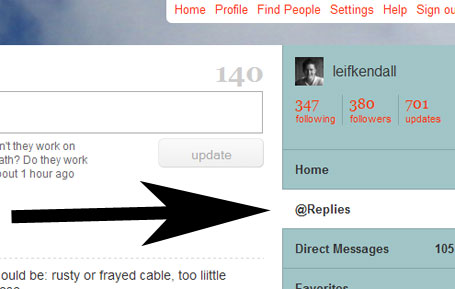
To get the most out of Twitter, it’s important to regularly check your @replies (see image below). If you use Twitter as a communications channel, it’s crucial that you catch the important messages that come your way.
As the global economic downturn continues to bite chunks out of our prosperity, people seek new ways to cut costs. ‘Credit crunch lunch’ is one of my favourite terms – describing a frugal feast – referring to anything from home-made sandwiches to budget banquets at upmarket eateries.
But a ‘credit crunch lunch’ is not always a happy meal; for one of my fellow co-werkers, the reality of the credit crunch lunch is this horrible mess:

What is this? I don’t know. I didn’t know the day it barked at me from the fridge and I don’t know now. Is it spam? Is it dog meat? Is it minced ham and chips?

Blogging is hard work. It’s not a quick, easy way to build web traffic. It’s time consuming and easy to get wrong. So should web developers and social media consultants be less keen to offer them to clients?
Andy Budd recently blogged about social media consultants, and his post got me thinking.
As Andy points out, many corporate blogs are dull, unpopular and don’t reward the effort expended on them. Some organisations are never going to be able to blog well. If everyone’s too busy – or too bored – to blog, what’s the point in having one?
Should web developers and social media consultants think twice before loading another organisation up with a blog? Perhaps there should be a test to prove commitment to the blog before you’re allowed to have one.
Of course, the question of whether blogs are suitable for an organisation applies to other social media tools. And I think that’s the point – not all social media tools suit all organisations.
It reminds of me of pet ownership. Everyone wants a pet, but nobody wants to pick up the poop, or walk it. Well, you want to walk it at first, when it’s fun. But then it’s cold, or raining, or Top Gear is on, and you don’t want to walk it any more. Who is going to keep blogging when Top Gear is on?

Caveat: Understanding Search Engine Optimisation is vital if you want to succeed online. An un-optimised website is a wasted opportunity. Pursuing higher rankings is a logical goal for most organisations with websites.
However, some SEO practices are not essential, not very effective and create a web of trash. Article marketing is a good example of a deeply inauthentic, junky marketing process that clutters the web with endlessly duplicated content.
Link-exchange sites and directories are also examples of eco-systems that exist purely for SEO purposes.
I tried article marketing. It seemed like a good idea – a way to share content and gain links. In reality, article repositories are dumps that only seem to be used by spam-merchants. (Feel free to tell me if you feel differently…)
I asked Google’s Matt Cutts what he thought about article marketing and web directories. While not damning, his views suggest that these SEO tactics aren’t the best way to approach SEO.
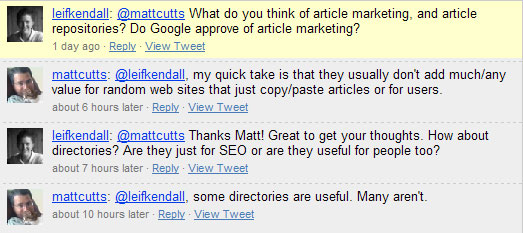
Article marketing is a very useful web marketing technique – providing you don’t use article repositories. With article repositories, your article will probably be reproduced on many low-grade websites with low (or nil) PageRank. The benefit in SEO terms is negligible – especially if Google decides to penalise you for duplicating content.
It’s also worth pointing out that because many spam-blogs will reprint your articles, you’ll have a bunch of links to your site from so-called bad neighbourhoods.
If you want to use article marketing to gain links to your website, and get your name in front of a new audience, then contribute fresh articles to quality websites. While this means more work, it will give you a genuine, high-quality audience and links from reputable sites that you can hand-pick.
SEO wizards realised that because Google loves content, and people love content, they should bulk up their websites with content.
The result? SEO companies pay students £10 (or less) to write generic articles about their clients’ businesses.
The result? Sub-prime content – not interesting, not relevant, not readable. This kind of content is aimed at search engines and link-building. It’s for robots, not humans.
The alternative to junk content written by anonymous students is authentic content created by an organisation’s own people. This is the difference between meaningful, interesting content and cheap, hollow filler.
Good SEO is about optimising content (and ensuring a website is optimised for search engines) not about creating content purely for optimisation.
SEO can often suggest useful additional content – which is fine. But junk content created purely for search engines creates a web of trash. Entire corners of the web are now stuffed with rubbish, creating a kind of SEO echo-chamber.
When planning your SEO, it’s important to realise that many popular tactics aren’t as useful as they seem. While many people invest in article marketing and web directories, they don’t always provide a good return.
I realise these are contentious issues, so I’d love to know what you think. Do article repositories, link exchanges and directories serve any real purpose? (A purpose beyond supporting the SEO industry.)
There are lots of web directories around – like Hot Frog, Carry On Surfing, Best of the Web, VivaStreet and Splut.
Now I know that everyone likes to submit their websites to directories because you get SEO-boosting links, but does anyone use these directories?
Who uses directories to look for a website or a particular type of business? If you regularly use web directories to find websites and businesses, please let me know.
Try everything. You can’t predict where you will find work, or where work will find you. Explore your business world.
Try a little of everything and see what works. Fortune favours the brave.
 Kendall Copywriting Ltd 2008 - 2026 Registered in England No. 6615703,
Registered Office: Unit 11, Hove Business Centre, Fonthill Road, Hove, BN3 6HA
